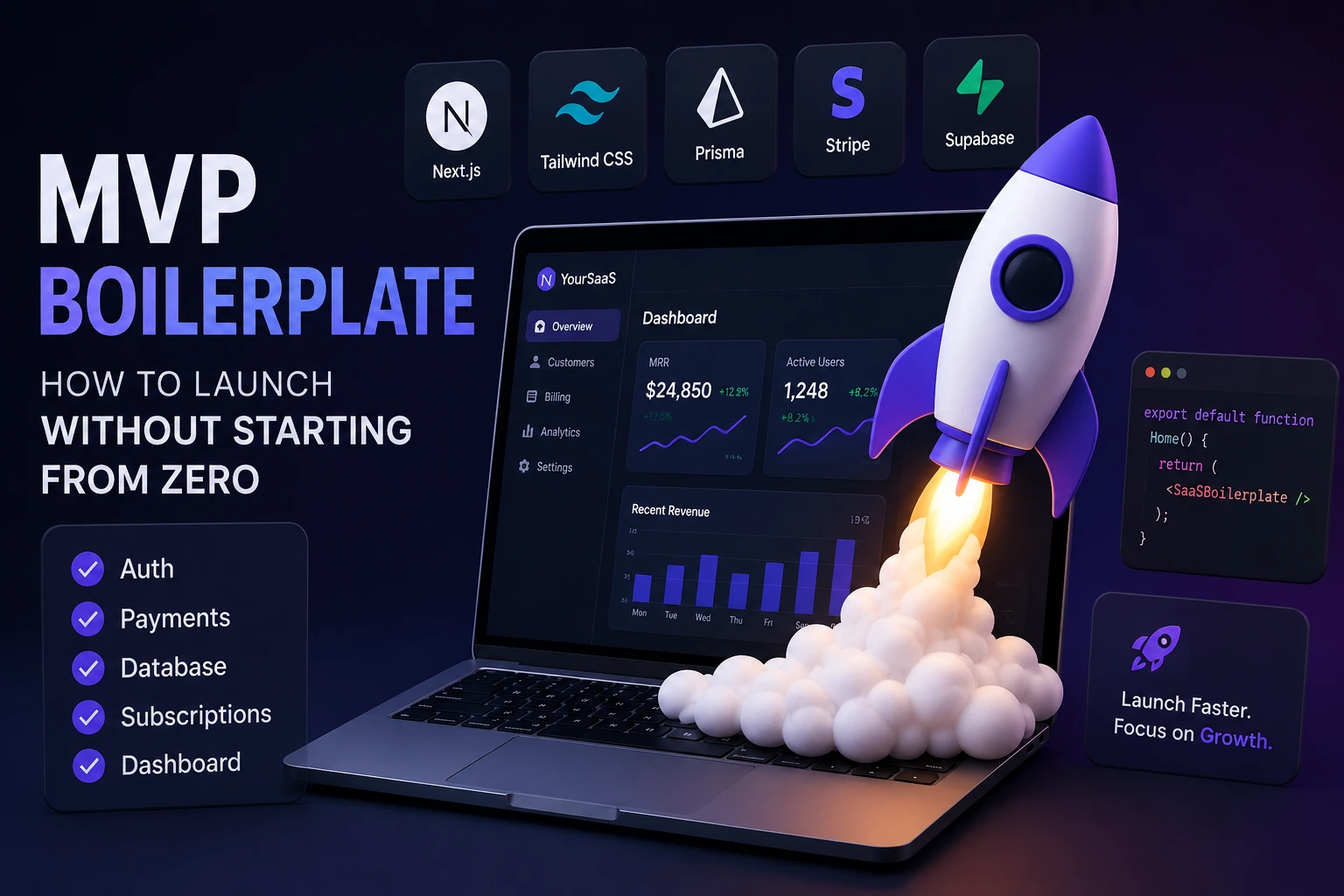
Every founder who has built a SaaS product from scratch has had the same moment. You have an idea. You open your editor. And then, before you write a single line of product code, you spend two weeks on authentication. Then another week on payments. Then a few days getting email to work. Then deployment. Then environment variables. Then you finally have a working app — and you have not built the thing you actually wanted to build yet.
An MVP boilerplate exists to skip that part. Not by doing it badly, but by doing it once, correctly, so you do not have to do it again.
This post covers what an MVP boilerplate actually gives you, what separates a good one from a bad one, and how to use one in a way that actually speeds you up rather than locking you in.
What an MVP Boilerplate Is
An MVP boilerplate is a pre-built starting point for a software product. It handles the infrastructure every app needs — authentication, payments, database, email, file storage, deployment configuration — so you can start on the actual product from day one.
The term gets misused. Some boilerplates are little more than a folder structure with a few packages installed. Others are opinionated, fully integrated stacks where every piece is already wired together and tested in production. The difference between those two things is enormous.
A folder structure with packages installed does not save you time. You still have to configure every integration, connect them to each other, handle the edge cases, and make sure none of them break when deployed. You just have a starting directory instead of a blank one.
A properly integrated boilerplate has already done all of that. The auth middleware is set up. The payment webhook is verified and handling errors. The emails are templated and ready to send. The database schema is defined and migrated. You clone it, add your API keys, and start building.
Why Starting From Zero Costs More Than You Think
The hidden cost of starting from zero is not just the time. It is the decisions.
Every integration you set up from scratch comes with dozens of decisions you have not made before. How should the middleware handle unauthenticated requests? When does the payment webhook fire, and what happens if it fires twice? Should the email template be a string, a JSON template, or a React component? What goes in the database and what stays in the session?
These are not hard decisions once you know the right answer. But when you are building from scratch, you do not know the right answer yet. You research, you read documentation, you try one approach, you find a problem with it, you try another. Each decision takes far longer than it should, and by the time you have made all of them, you have spent three weeks on things that have nothing to do with your product.
An MVP boilerplate that is genuinely production-ready has already made those decisions for you. Not arbitrarily — based on what actually works in a real deployed app. That is the thing you are really paying for.
What a Good MVP Boilerplate Covers
Not every boilerplate is worth using. Here is what a good one actually includes, and why each piece matters.
Authentication
Auth is the single most common time sink in a new project. A good MVP boilerplate does not just install an auth library — it sets up the full flow: sign-up, sign-in, email verification, password reset, OAuth providers, and middleware-level route protection. It also handles the edge cases, like redirecting authenticated users away from auth pages and protecting API routes.
If a boilerplate only shows you how to call useUser(), that is not an auth integration. That is a starting point for building one.
Payments
Payments are the second most common time sink. A complete payment integration means Stripe Checkout, webhook handling with signature verification, idempotency guards so duplicate events do not cause double-charging, and order confirmation. It should support both one-time purchases and subscriptions, and the webhook handler should be structured so adding new event types does not require rewriting the whole thing.
Transactional email
Welcome emails, receipts, password resets — these need to work on day one. A solid MVP boilerplate has a transactional email setup with real templates, not just an API client you have to build on top of.
Database
A working Prisma schema, migrations, and a connection setup that does not leak connections in a serverless environment. The schema should reflect real app models, not just an empty file with a comment.
Content system
A blog and documentation section matters more than most developers realize when launching an MVP. Content drives discovery before you have paid channels. A boilerplate that includes an MDX-based blog and docs system means you can start writing for SEO on day one instead of week six.
Analytics
Knowing what users actually do in your product is not optional. A good boilerplate has analytics wired in correctly — not just a tracking script, but proper initialization, event capture setup, and GDPR compliance handled by default.
What to Watch Out For
Not everything called a boilerplate or starter kit is worth using. A few things to watch out for:
Installed but not configured
The most common problem with free or lightweight boilerplates is that they install the packages but do not configure the integrations. You still have to read the Stripe docs, figure out the webhook setup, and handle the edge cases yourself. That might take almost as long as starting from scratch, and you also have to understand someone else's project structure while you are doing it.
Outdated dependencies
A boilerplate using Next.js 12, deprecated auth libraries, or Stripe's old API version is not a shortcut. It is a debt you are inheriting. Check when the boilerplate was last updated and whether the major dependencies are current versions.
No production evidence
A boilerplate that has never been deployed to production will have gaps you do not discover until you are in production. Error handling that only covers the happy path. Webhook logic that works locally but breaks under retry conditions. Missing CORS headers. Environment variable handling that works in development but breaks in a CI pipeline. Look for boilerplates that have been built from real production apps.
Too much, too specific
Some boilerplates are so opinionated that they are really just someone else's app with the product code removed. If removing their specific use case requires deleting more code than you will write, that is not a starting point — it is a migration project.
How to Use an MVP Boilerplate Effectively
Getting a boilerplate is not the same as having a foundation. How you use it matters.
Read it before you build on it
Before writing any product code, spend a few hours reading through the boilerplate. Understand how auth flows work, how the payment route handles errors, how the database client is initialized. You do not need to understand every line, but you need to understand the shape of the thing you are building on. If something breaks in production, you need to know where to look.
Add your product code in the right places
The structure of a good boilerplate tells you where product code belongs. API routes go in app/api/. Business logic goes in lib/. Components go in components/. Do not fight the structure — follow it. Consistency makes future you much happier.
Extend incrementally
The most common mistake after getting a boilerplate running is trying to add everything at once. Resist that. Get one complete workflow working end to end — a user can sign up, complete a purchase, and access the product — before adding anything else. That first working flow is your proof of concept. Build on it.
Keep the core integrations up to date
A boilerplate is not a one-time thing. Stripe releases new API versions. Auth libraries get security updates. Next.js ships new features. Treat the boilerplate's dependencies like any other dependency in a production app — update them regularly and read the changelogs when major versions change.
How Plainform Approaches This
Plainform is an MVP boilerplate built for developers who need to move fast without sacrificing quality. Every integration in it comes from real production use — not just reading the documentation, but shipping apps that handle real users, real payments, and real edge cases.
Authentication is handled by Clerk, fully configured with sign-in, sign-up, OAuth, password reset, email verification, and middleware-level route protection. Payments use Stripe with manual payment capture for one-time purchases, webhook signature verification, idempotency guards, and structured webhook dispatching that makes adding new event types trivial. Email goes through Resend with React Email templates that can be previewed locally. The database is PostgreSQL with Prisma, hosted on any provider that supports PostgreSQL. Analytics runs through PostHog with EU data residency and GDPR-compliant cookieless mode by default.
The content system — blog and documentation — is built on Fumadocs and MDX, which means you can write and publish content without any additional setup. The environment variables are validated at build time with @t3-oss/env-nextjs and Zod, so a missing API key fails the build rather than silently breaking in production.
None of these are partial integrations. The Stripe webhook handles retries and signature verification. The auth middleware redirects authenticated users away from auth pages. The email templates are production-ready. The Prisma setup uses a singleton pattern that survives serverless cold starts.
That is the difference between an MVP boilerplate and a list of packages.
The Real Value of a Good Boilerplate
The time you save by starting with an MVP boilerplate is significant. Two or three weeks of setup work, eliminated. But that is not actually the most valuable thing.
The most valuable thing is what that time does to your momentum. When you sit down on day one and the infrastructure is done, you get to build something that looks and feels like a real product immediately. Features take shape. The product starts to feel real. You start getting feedback faster.
That momentum is hard to quantify and easy to underestimate. Most MVPs die not because the idea was bad, but because the founder ran out of energy before they shipped. Every week you spend on infrastructure is a week the product does not get in front of users, a week your motivation has to sustain itself without external validation, a week closer to the point where you wonder if it is worth continuing.
An MVP boilerplate does not just save weeks. It saves the project.
Conclusion
Starting from zero is always an option. Sometimes it is even the right one. But for most SaaS products, the foundation is solved infrastructure — authentication, payments, email, database, analytics — that has the same right answers every time. The unique thing about your product is not how it handles a Stripe webhook. It is what it does for the people who use it.
An MVP boilerplate lets you skip to the part that matters. Choose one that is genuinely production-ready, understand the foundation you are building on, and spend your time on the product that only you can build.
That is how you launch without starting from zero.